Explore a career in the automotive industry, enhance your skills or start your own business.



Transportation Career Field Courses
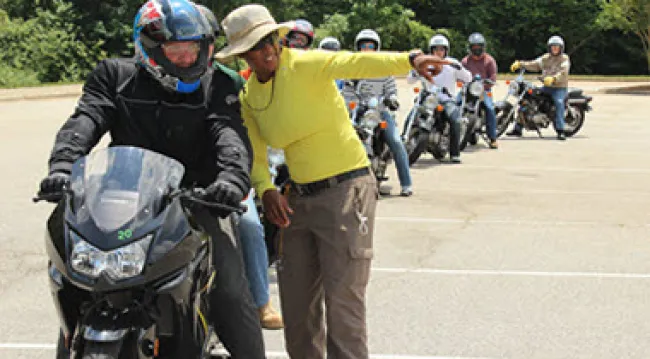
Motorcycle Basic Rider Course
- Course ID: CSP-4000A3
- Overview
- Course Outline
- Requirements
- Intended Audience
- More Details
Course Objectives
Upon successful completion of the course students will acquire skills needed for safe motorcycle riding and will receive an MSF endorsement card, which will allow them to waive the NCDMV riding test.
Outline of Instruction
• Introduction to motorcycling
• Protective gear / What to wear
• Controls such as the clutch and brakes
• Pre-ride inspection of your motorcycle
• Preparing to ride your motorcycle on the class range
• Street strategies to avoid trouble and stay safe
• Driving and riding impairments such as use of alcohol and drugs
• How to maneuver your motorcycle
• Avoiding obstacles
• Lane changes
• Passing
• Riding at night
• Collision avoidance skills
• Swerving
• Special situations
• Carrying a passenger or cargo
• Dealing with tire failure
• Dealing with animals
• And other topics all included increasing your motorcycle riding enjoyment and safety.
Contact Hours
19
CEUs
No
Industry Standard, State or National Certification
Certification
None
Website
None
Certification Learning Outcomes/Requirements
CE or CU Articulation
No
Prerequisites
Good bicycle experience
Learning Supplies Needed
Students are responsible to complete e-course and bringing additional supplies for the course as listed online at the time of registration.
Clinical Site/Special Facilities
None
Requirements for Successful Completion
100% attendance
Accreditation/Special Approval Requirements
N/A
Intended Audience
Potential Students interested in learning to ride motorcycles and obtaining their motorcycle license from the DMV.
Specific Industry or Business Support Needs
N/A
Wake County Need for Industry Positions
N/A
Industry or Job Titles Related to Training Outcomes for Employment
Related Courses
Course Contact Information
Community & Career Education Staff
919-532-5700
[email protected]
| Details | Section | Date(s) | Location | Price | Seats | |
|---|---|---|---|---|---|---|
| 329493 | 09/19/26 - 09/20/26 | Southern Wake Campus | 299.00 | 0 | ||
| 329494 | 09/26/26 - 09/27/26 | Southern Wake Campus | 299.00 | 0 | ||
| 330292 | 10/03/26 - 10/04/26 | Southern Wake Campus | 296.00 | 0 | ||
| 330293 | 10/10/26 - 10/11/26 | Southern Wake Campus | 299.00 | 0 | ||
| 330295 | 10/17/26 - 10/18/26 | Southern Wake Campus | 299.00 | 12 |
Course Cancelled
|
|
| 330299 | 10/24/26 - 10/25/26 | Southern Wake Campus | 299.00 | 0 | ||
| 334323 | 11/07/26 - 11/08/26 | Southern Wake Campus | 299.00 | 0 | ||
| 334324 | 11/14/26 - 11/15/26 | Southern Wake Campus | 299.00 | 0 | ||
| 334325 | 11/21/26 - 11/22/26 | Southern Wake Campus | 299.00 | 0 | ||
| 334330 | 12/05/26 - 12/06/26 | Southern Wake Campus | 299.00 | 0 | ||
| 334331 | 12/12/26 - 12/13/26 | Southern Wake Campus | 299.00 | 10 | Register |
If you would like to be notified when additional sections become available, please use Wake Tech’s Notify Me service for CSP-4000A3-Motorcycle Basic Rider Course .
Escort Vehicle Driver Certification
- Course ID: SEF-3001F7
- Overview
- Course Outline
- Requirements
- Intended Audience
- More Details
Course Objectives
Acquire the necessary instruction in safe and effective escort skills
Satisfied the educational requirements of the North Carolina Department of Transportation Oversize-Overweight Load Escort Vehicle Driver Certification Program
Outline of Instruction
State of North Carolina Escort Vehicle Certification Program
Functions and Duties of Escort Drivers
Highway Operations
Breakdowns and Emergency Operations
Escort Vehicle Operation and Defensive Driving
Review and Final Exam
Contact Hours
8
CEUs
Yes
Industry Standard, State or National Certification
Certification
North Carolina Department of Transporation Oversize/Overweight Permits Unit
Website
https://connect.ncdot.gov/business/trucking/Pages/overpermits.aspx
Certification Learning Outcomes/Requirements
Upon successful completion of this program, participants will have received instruction in safe and effective escort skills, achieved a passing score on the final examination that documents course comprehension and a system of recognizing drivers certified by this or another state.
Upon successful completion of this course, participants will be eligible to be certified as oversize-overweight load escort vehicle drivers as required by G.S. 20-119 and detailed in 19A NCAC 02D.0644.
CE or CU Articulation
No
Prerequisites
N/A
Learning Supplies Needed
North Carolina Department of Transportation Certified Escort Vehicle Operator Handbook (https://connect.ncdot.gov/business/trucking/OversizeOverweight%20Permit…)
Clinical Site/Special Facilities
None
Requirements for Successful Completion
100% attendance
Students must score 75% or higher on the final examination. No makeup testing dates will be offered.
Accreditation/Special Approval Requirements
North Carolina Department of Transportation Oversize/Overweight Permits Unit Accredited School
North Carolina Department of Transportation Oversize/Overweight Permits Unit Approved Curriculum
North Carolina Department of Transportation Oversize/Overweight Permits Unit Certified Instructor
Intended Audience
Students interested in becoming a Certified Escort Vehicle drivers
Specific Industry or Business Support Needs
Escort Vehicle Driver, Pilot Driver and/or Pole Driver
Wake County Need for Industry Positions
Yes
Industry or Job Titles Related to Training Outcomes for Employment
Escort Drivers
Related Courses
AUT-3002A3
AUT-3129A3
SEF-3001BU2
Course Contact Information
Bill Lurie Program Director & Rochelle Waters, Transportation Coordinator
[email protected] & [email protected]
| Details | Section | Date(s) | Location | Price | Seats | |
|---|---|---|---|---|---|---|
| 334559 | 09/30/26 - 09/30/26 | Northern Wake Campus | 109.00 | 8 | Register |
If you would like to be notified when additional sections become available, please use Wake Tech’s Notify Me service for SEF-3001F7-Escort Vehicle Driver Certification .
N.C. On-Board Diagnostics (OBD II) Vehicle Emission Inspection
- Course ID: SEF-3001G7
- Overview
- Course Outline
- Requirements
- Intended Audience
- More Details
Students must have safety glasses, PPE (full-length pants and closed-toe shoes), a pen or pencil, note paper and an ISU-310 Action Form-Revised 06/2026 (signed by employer). Students who don't come prepared with these items will be asked to transfer to another course.
Course Objectives
Identify vehicles that require an OBD II inspection
List in writing the fees associated with an OBD II inspection and identify when they apply
Explain when a waiver of the inspection requirements may be issued
Identify the emission-control components installed on vehicles
Outline of Instruction
Introduction
Station Qualifications
Mechanic Qualifications
Emissions Analyzers
Cause and Effects of Air Pollution
Vehicle-Generated Pollutants
Purpose of the Inspection Program
Vehicle Emissions Standards
Emission-Control Devices
Malfunction Indicator Lamp (MIL)
Diagnostic Trouble Codes (DTC)
Data Link Connector (DLC)
Readiness Monitors
OBD II Subject Vehicles
Exceptions to OBD II Inspections
Pre-Inspection Requirements
Entering Vehicle Data
Conducting the OBD II Inspection
Fee Schedule
Warranty Information
Waivers
Exemptions
Violations
Conclusion
Contact Hours
8
CEUs
Yes
Industry Standard, State or National Certification
Certification
N.C. State Highway Patrol Investigative Services Unit
Website
https://www.ncshp.gov/investigative-services-unit/documents
Certification Learning Outcomes/Requirements
Vehicle Emission Inspection Mechanic License
CE or CU Articulation
No
Prerequisites
N/A
Learning Supplies Needed
Safety glasses
Personal protective equipment (PPE)
Pen/pencil
Note paper
ISU-310 Action Form-Revised 06/2026 (signed by employer)
Clinical Site/Special Facilities
Classroom with a projector, a facility to conduct auto inspection using safety inspection equipment, including an auto lift and an emission analyzer
Requirements for Successful Completion
100% attendance
Late students will not be admitted to class. Students with less than 100% attendance or who are unable to demonstrate competency receive a grade of NG (no grade).,Students conduct an emissions inspection of a motor vehicle, and a passing score of 80% or higher is required on both the written and hands-on tests.,State-issued ID and station number,Students must arrive on time on testing day. Students will not be allowed into the classroom after the test begins, and no makeup testing dates are offered.
Accreditation/Special Approval Requirements
An emissions inspector mechanic must have successfully completed an eight-hour training course approved by the N.C. State Highway Patrol Investigative Services Unit. Passing scores on both a written test and a hands-on test in which the student is required to conduct an emissions inspection of a motor vehicle are required.
Intended Audience
Auto mechanics
Specific Industry or Business Support Needs
Vehicle emission inspection mechanics
Wake County Need for Industry Positions
Class A mechanic
Industry or Job Titles Related to Training Outcomes for Employment
Vehicle emission inspection mechanics
Related Courses
AUT-3129D3
Course Contact Information
Bill Lurie Program Director & Rochelle Waters, Transportation Coordinator
[email protected] & [email protected]
| Details | Section | Date(s) | Location | Price | Seats | |
|---|---|---|---|---|---|---|
| 335224 | 09/23/26 - 09/24/26 | Northern Wake Campus | 105.00 | 0 | ||
| 335547 | 09/30/26 - 10/01/26 | Northern Wake Campus | 100.00 | 8 | Register | |
| 335659 | 10/07/26 - 10/08/26 | Northern Wake Campus | 100.00 | 18 | Register | |
| 335660 | 10/14/26 - 10/15/26 | Northern Wake Campus | 100.00 | 17 | Register | |
| 335696 | 10/21/26 - 10/22/26 | Northern Wake Campus | 100.00 | 20 | Register | |
| 335698 | 10/30/26 - 10/30/26 | Northern Wake Campus | 100.00 | 13 | Register |
If you would like to be notified when additional sections become available, please use Wake Tech’s Notify Me service for SEF-3001G7-N.C. On-Board Diagnostics (OBD II) Vehicle Emission Inspection .
N.C. Vehicle Safety Inspection
- Course ID: SEF-3001BU2
- Overview
- Course Outline
- Requirements
- Intended Audience
- More Details
NOTE: Successful completion of this course requires 100% attendance and satisfactory class participation; late students may not be admitted.
Students must come to class with the following:
PPE (full-length pants and closed-toe shoes)
Pen/pencil
ISU-310 Action Form-Revised 06/2026, signed by employer
Students who show up to class not prepared with these items will be asked to transfer to another course.
Course Objectives
List the nine inspection areas inspector mechanics must check during a safety inspection
Identify eight emission-control devices installed by vehicle manufacturers
Determine what emission-control devices are required on a vehicle by using the Emission Control System Applications Manual
Calibrate and utilize a headlight aimer
Calibrate and utilize a window tint meter
Using the safety inspection regulation manual, successfully complete a North Carolina State Safety Inspection
Outline of Instruction
Introduction
Inspection Fees
Technician Qualifications
Inspection Procedure
Vehicle Components
19A NCAC 03D .0541 Exhaust Emission Controls
19A NCAC 03D .0542 Emission Control Device
§ 20-183.8A. Civil Penalties Against Motorists for Emission Violations; Waiver
19A NCAC 03D .0544 Safety Inspection of Motorcycles
Emission Control Device Exemption
19A NCAC 03D .0551 Window Tinting
§ 20-127(c) Tinting Exceptions
Medical Exemption
Safety Analyzer Operating Procedure
Penalty Schedule for Licensed Safety/OBD Inspection Stations
Inspections Update
Noteworthy Topics
Conclusion
Contact Hours
8
CEUs
Yes
Industry Standard, State or National Certification
Certification
N.C. State Highway Patrol Investigative Services Unit
Website
https://www.ncshp.gov/investigative-services-unit/documents
Certification Learning Outcomes/Requirements
North Carolina State Safety Vehicle Inspector
CE or CU Articulation
No
Prerequisites
N/A
Learning Supplies Needed
Safety glasses
Personal protection equipment (PPE) – long pants and closed-toe shoes are required
Pen/pencil
Note paper
ISU-310 Action Form-Revised 06/2026, signed by employer
DMV-approved material provided by the college – Safety Inspection/Emission Inspection Regulations and Emission Control System Application Manual
Clinical Site/Special Facilities
Classroom with projector, facility to conduct auto inspection using safety inspection equipment, including auto lift and emission analyzer
Requirements for Successful Completion
100% attendance
Late students are not admitted to class. Students with less than 100% attendance or those who are unable to demonstrate competency receive a grade of NG (no grade).,Students must be able to demonstrate proficiency in all concepts taught.,Students conduct an emissions inspection of a motor vehicle, and a passing score of 80% or higher is required on both the written and the hands-on tests.,State-issued ID and station number.,Students must arrive on time on testing day. Students will not be allowed into the classroom after the test begins, and no makeup testing dates are offered.,Safety glasses,Personal protection equipment (PPE),Pen/pencil,Note paper
Accreditation/Special Approval Requirements
Applicants meeting the state requirements and successfully completing the end-of-course test are able to obtain or renew their license as a safety inspection mechanic.
Intended Audience
Auto mechanics
Specific Industry or Business Support Needs
N/A
Wake County Need for Industry Positions
N/A
Industry or Job Titles Related to Training Outcomes for Employment
North Carolina State Safety Vehicle Inspector
Related Courses
Course Contact Information
Bill Lurie Program Director & Rochelle Waters, Transportation Coordinator
[email protected] & [email protected]
| Details | Section | Date(s) | Location | Price | Seats | |
|---|---|---|---|---|---|---|
| 334556 | 09/18/26 - 09/18/26 | Northern Wake Campus | 105.00 | 0 | ||
| 334602 | 10/09/26 - 10/09/26 | Northern Wake Campus | 105.00 | 0 | ||
| 334603 | 10/23/26 - 10/23/26 | Northern Wake Campus | 105.00 | 10 | Register | |
| 334605 | 10/28/26 - 10/29/26 | Northern Wake Campus | 105.00 | 10 | Register |
If you would like to be notified when additional sections become available, please use Wake Tech’s Notify Me service for SEF-3001BU2-N.C. Vehicle Safety Inspection .
Automotive Maintenance and Light Repair
- Course ID: AUT-3137A7
- Overview
- Course Outline
- Requirements
- Intended Audience
- More Details
Course Objectives
This class will cover the basics in the following ASE training areas: engine repair, automatic transmission/transaxle, manual drive train and axles, suspension and steering, brakes, electrical/electronic systems, heating and air conditioning, and engine performance.
Outline of Instruction
Engine Repair (Introduction to Automotive Industry, Hand Tool Identification (NC3), Shop Safety and Vehicle Lifting, Vehicle Inspection Demo and Practice, Lubricants Presentation, Oil Change Demonstration and Practice, Engine Tear Down and Parts ID (Demo Engine), and Drive Belt Replacement Exercise)
Bolt and Nut ID, Measuring and Service Literature (Bolt and Nut ID Presentation and Exercise, Torque Wrench Demonstration and Practice, Basics of Measuring Presentation and Exercise, ShopKey Pro Service and Repair Level 1 (NC3), and Repair Order Basics Presentation and Exercise)
Transmissions (Transmission Basics Presentation, Fluid Level and Condition Checking Presentation and Exercise, Driveline Presentation and ID Exercise, and Driveshaft/U-Joint/CV Axle Inspection Demonstration and Removal Exercise)
Suspension and Steering (Tire ID and Inspection Presentation and Exercise, Tire Dismount/Mount and Balance Presentation and Exercises, Resetting Tire Pressure Monitoring Exercise, Steering and Suspension Systems Presentation and ID Exercise, and Alignment Demonstration)
Brakes (Braking Basics Presentation, Brake Parts ID Exercise, Brake Fluid Testing Demonstration, Brake Pad and Rotor Measurements Demonstration and Exercise, Brake Pad and Rotor Removal and Replacement Exercise, and Electronic Parking Brake Resetting)
Electrical/Electronic Systems (Battery/Starting/Charging System Design Presentation, Battery Testing and Removal Exercise, Starting/Charging System Testing Demonstration and Certification (NC3), Multimeter Usage and 525F Multimeter Certification (NC3), and Relay and Circuit Testing Practice)
Engine Performance (Fuel System Basics Presentation, Fuel Filter Removal and Replacement Exercise, Air Delivery Basics Presentation, Air Filter Removal and Replacement Exercise, Ignition System Basics Presentation, and Spark Plug Removal and Replacement Exercise)
Contact Hours
96
CEUs
Yes
Industry Standard, State or National Certification
Certification
Automotive Service Excellence (ASE) & National Coalition of Certification Centers (NC3)
Website
https://www.ase.com
https://www.nc3.net
Certification Learning Outcomes/Requirements
CE or CU Articulation
No
Prerequisites
None
Learning Supplies Needed
None
Clinical Site/Special Facilities
None
Requirements for Successful Completion
90% attendance
If a student has extenuating circumstances causing absences of greater than 10% of the class time, the student must make arrangements with the instructor to provide evidence of keeping up with the class material and making up the work, exercises and projects missed or demonstrate competency in the course objectives. Students with irregular attendance, less than 90% attendance, or unable to demonstrate competency will receive a grade of NG (no grade).,Lab exercises, when applicable, are due on the date assigned by the instructor. Late assignments may be accepted only at the instructor's discretion.
Accreditation/Special Approval Requirements
N/A
Intended Audience
Students interested in Automotive Repair
Specific Industry or Business Support Needs
Auto Servicing and Repair
Wake County Need for Industry Positions
Automotive Maintenance Technicians
Industry or Job Titles Related to Training Outcomes for Employment
Entry-Level: Automotive Maintenance Technician
Related Courses
AHS-AUTE1
AHS-AUTE2
Course Contact Information
Bill Lurie Program Director & Rochelle Waters, Transportation Coordinator
[email protected] & [email protected]
No active courses available at this time.
To be notified when this course becomes available, please use
Wake Tech’s Notify Me service
for AUT-3137A7-Automotive Maintenance and Light Repair
.
Auto Body Restoration - Project Based Class
- Course ID: AUT-3109B7
- Overview
- Course Outline
- Requirements
- Intended Audience
- More Details
Course Objectives
Correctly use equipment used in the restoration of vehicles to repair and restore a vehicle
Recognize the major technological systems of the automobile
Explain authentic antique automobile restoration materials, methods and techniques
Use materials and tools necessary to complete authentic automobile restoration work
Demonstrate the attitudes, knowledge and skills necessary to pursue a successful career in antique automobile restoration
Outline of Instruction
Understanding elements involved with auto body repair and paint
Paint and body shop safety (basic first aid)
General hand tools and power tools (use and identification)
Body fillers (plastic and fiberglass)
Mixing and applying undercoats
Mixing and applying topcoats
Refinishing equipment
Fasteners
Contact Hours
100
CEUs
No
Industry Standard, State or National Certification
Certification
Inter-Industry Conference on Auto Collision Repair (I-CAR)
Website
Certification Learning Outcomes/Requirements
CE or CU Articulation
No
Prerequisites
N/A
Learning Supplies Needed
Students will be responsible for basic hand tools to support the vehicle project student is working on: Body pack hammer, body dolly, DA sander, angle die grinder with grinder disk, air blowgun, 1/4" drive socket set (standard and/or metric) 3/8" drive socket set (standard and/or metric) combination wrench set (standard 7/16-9/16 or metric 6mm-16mm), screwdrivers (common, Phillips, Torx), ball-peen hammer.
Clinical Site/Special Facilities
Students are not allowed to use any tools or equipment unless they are properly trained. Students are not allowed to use equipment unless given permission and supervised by the instructor (i.e.-frame machine, welding equipment, etc.). Students are only allowed to work on one car at a time in the shop.
Requirements for Successful Completion
90% attendance
Accreditation/Special Approval Requirements
Students must have prior approval on project before entering the class. Students must be enrolled in Collision or have taken a CE Collision & Paint class prior to being able to bring in a personal project.
Intended Audience
Students interested in vehicle restoration and repair
Specific Industry or Business Support Needs
Auto Collison Repair
Wake County Need for Industry Positions
Auto Body Paint Prepper
Industry or Job Titles Related to Training Outcomes for Employment
Auto Body Repair or Restoration
Related Courses
AHS-AUTE1
Course Contact Information
Bill Lurie Program Director & Rochelle Waters, Transportation Coordinator
[email protected] & [email protected]
No active courses available at this time.
To be notified when this course becomes available, please use
Wake Tech’s Notify Me service
for AUT-3109B7-Auto Body Restoration - Project Based Class
.
Forklift Operator Training
- Course ID: OSH-3012B7
- Overview
- Course Outline
- Requirements
- Intended Audience
- More Details
Course Objectives
know the OSHA regulations along with the operation and maintenance of an industrial forklift.
Outline of Instruction
OSHA REGULATIONS
Lift truck operating principles and design
Pre-shift inspection and preventive maintenance
Worksite inspections
Picking up a load
Delivering a load
Apply lift truck operator safety skills
Contact Hours
8
CEUs
Yes
Industry Standard, State or National Certification
Certification
National Safety Council
Website
Certification Learning Outcomes/Requirements
Forklift Operators Certificate
CE or CU Articulation
No
Prerequisites
Students need to be 18 years or old and have a valid drivers' license.
Learning Supplies Needed
Lift Truck Operator Training Textbook- Book is provided on day one of class
Clinical Site/Special Facilities
Open bay area
Requirements for Successful Completion
100% attendance
Work boots,Work Gloves,Eye protection,Driver's License
Accreditation/Special Approval Requirements
National Safety Council
Intended Audience
Those interested in a fast paced non-traditionally work week. Those interested in a national credential leading to employment. Warehouse workers, loading dock workers, freight and moving company workers.
Specific Industry or Business Support Needs
N/A
Wake County Need for Industry Positions
N/A
Industry or Job Titles Related to Training Outcomes for Employment
| Details | Section | Date(s) | Location | Price | Seats | |
|---|---|---|---|---|---|---|
| 335038 | 09/19/26 - 09/19/26 | Southern Wake Campus | 90.00 | 3 | Register | |
| 335105 | 10/03/26 - 10/03/26 | Southern Wake Campus | 90.00 | 5 | Register | |
| 335106 | 10/17/26 - 10/17/26 | Southern Wake Campus | 90.00 | 8 | Register |
If you would like to be notified when additional sections become available, please use Wake Tech’s Notify Me service for OSH-3012B7-Forklift Operator Training .
Hybrid and Electric Vehicle Safety and Technology
- Course ID: AUT-3137G7
- Overview
- Course Outline
- Requirements
- Intended Audience
- More Details
Course Objectives
Locate relevant safety information
Discuss and demonstrate how to properly disable high-voltage systems on modern hybrid and electric vehicles
Properly identify high-voltage cables and components on modern hybrid and electric vehicles
Discuss the advantages and disadvantages of battery electric, hybrid and plug-in hybrid-powered vehicles
Understand the different types of hybrid and electric vehicles
Discuss the charging infrastructure and what the future holds for EVs
Discuss vehicle charge times and why they differ depending on the location and charger being used
Outline of Instruction
This course covers hybrid electric vehicles (HEVs), plug-in hybrid electric vehicles (PHEVs). This course introduces the different types of charging stations and station safety systems as well as different vehicles under each category. Students learn how to recognize the different Advanced Electric Drive Vehicles and their components. This workshop reviews how you should approach and assess an incident.
Contact Hours
8
CEUs
No
Industry Standard, State or National Certification
Certification
None
Website
None
Certification Learning Outcomes/Requirements
CE or CU Articulation
No
Prerequisites
N/A
Learning Supplies Needed
None
Clinical Site/Special Facilities
None
Requirements for Successful Completion
80% attendance
Accreditation/Special Approval Requirements
N/A
Intended Audience
Specific Industry or Business Support Needs
N/A
Wake County Need for Industry Positions
N/A
Industry or Job Titles Related to Training Outcomes for Employment
Related Courses
Course Contact Information
Bill Lurie Program Director & Rochelle Waters, Transportation Coordinator
[email protected] & [email protected]
No active courses available at this time.
To be notified when this course becomes available, please use
Wake Tech’s Notify Me service
for AUT-3137G7-Hybrid and Electric Vehicle Safety and Technology
.
Automotive Electrical
- Course ID: AUT-3137H7
- Overview
- Course Outline
- Requirements
- Intended Audience
- More Details
Course Objectives
Observe and perform safety procedures related to electrical systems
Identify vehicle identification numbers, electronic service information and service repair orders
Methodically approach and diagnose problems in electrical systems to make a direct, thorough and economical diagnosis
Do basic testing and service on battery, starting, charging and basic electrical systems
Perform basic "in-car" diagnostics and repairs
Understand the basic concepts and procedures to successfully repair late-model battery, starting, charging and basic electrical systems
Outline of Instruction
Circuit Testing
Shorted circuit (short to power, short to ground), open circuit, grounded circuit, intermittent circuit problems, voltage drops, amperage draw
Battery
Safety procedures, open flame and explosion hazard, removal and installation procedure, basic construction and chemical action, sizes and ratings, testing/service (state of charge, cell voltage, capacity test, sulphation, battery charging procedure, clean/fill/replace, jump starting, replace cables and clamps, constant battery drain), interpretation of test results and problem/diagnosis (corroded connections, leakage, no-start complaints, slow cranking complaints, excessive water use, discharges overnight, damaged plates)
Charging System
Basic system components, purpose and operation (diodes, rotor, stator); circuit operation (various system schematics, voltage regulation, current control, light relay, field relay, ammeter circuit); test equipment (voltmeter, ammeter, ohmmeter, diode testers); test hook-up and interpretation of results (field circuit, output test); problem and diagnosis (loose belts, defective diode(s), noises – bearings, belts, mounting, diode – undercharge conditions, no-charge conditions, overcharge conditions, defective regulator)
Starter (Cranking) System
Basic function, types and basic differences (moveable pole shoe, permanent magnet types, gear reduction types), relays and solenoids, construction and nomenclature of parts, starter drives (Bendix, overrunning clutch), testing/service (ground circuit voltmeter readings, remote cranking, inspecting control circuit wiring), problem/diagnosis ("chatter" noise. defective starter drive, worn bushings, worn flywheel ring gear, starter alignment, noise when cranking, high current draw, low current draw, will not crank, cranks slowly, worn brushes/holders, spins but will not engage)
Starter Circuit Controls (understand basic operation)
Relays, solenoids, neutral safety switches, ignition switches (including removal replacement) and circuit testing (voltage drop acceptable readings, solenoid/relay tests, supply circuit and control circuit)
Contact Hours
96
CEUs
No
Industry Standard, State or National Certification
Certification
National Coalition of Certification Centers (NC3)
Website
Certification Learning Outcomes/Requirements
CE or CU Articulation
No
Prerequisites
None
Learning Supplies Needed
None
Clinical Site/Special Facilities
None
Requirements for Successful Completion
90% attendance
Accreditation/Special Approval Requirements
N/A
Intended Audience
Specific Industry or Business Support Needs
Auto Technicians
Wake County Need for Industry Positions
N/A
Industry or Job Titles Related to Training Outcomes for Employment
Related Courses
AUT-3001A3
AHS-AUTEL
Course Contact Information
Bill Lurie Program Director & Rochelle Waters, Transportation Coordinator
[email protected] & [email protected]
No active courses available at this time.
To be notified when this course becomes available, please use
Wake Tech’s Notify Me service
for AUT-3137H7-Automotive Electrical
.
Advanced Automotive Technician Training with NCSI/OBD
- Course ID: AUT-3137I7
- Overview
- Course Outline
- Requirements
- Intended Audience
- More Details
Course Objectives
Students will learn Shop key, Scanner & Lab scope, Basic Automotive Electrical, Lift Safety, Alignment, Digital Vehicle inspections, AC Diagnostics & will include NC safety & Vehicle Inspections. Students will learn via theory and hands on lab time.
Outline of Instruction
Shop Key
Scanner & Lab Scope Training
Basic Automotive Electricity
Lift Safety
Alignment
Digital Vehicle Inspection
NC Vehicle Inspection
NC Safety Inspection
Air-Conditioning Diagnostics
ASE Test Prep
Contact Hours
96
CEUs
No
Industry Standard, State or National Certification
Certification
ASE- National Institute for Automotive Service Excellence
Website
Certification Learning Outcomes/Requirements
CE or CU Articulation
No
Prerequisites
None
Learning Supplies Needed
Safety glasses
Personal Protection Equipment (PPE)
Pen/pencil
Note paper
LT-310 Action Form-Revised
DMV approved material and provided by the college.
Clinical Site/Special Facilities
None
Requirements for Successful Completion
80% attendance
Students must pass NC Safety & Vehicle with 80% or higher
Accreditation/Special Approval Requirements
N/A
Intended Audience
Specific Industry or Business Support Needs
Automotive Technician
General Service Technician
Wake County Need for Industry Positions
N/A
Industry or Job Titles Related to Training Outcomes for Employment
Related Courses
AUT-3001A3
AUT-3002A3
AHS-AUTE1
AHS-AUST2
AHS-AUTS1
Course Contact Information
Bill Lurie Program Director & Rochelle Waters, Transportation Coordinator
[email protected] & [email protected]
No active courses available at this time.
To be notified when this course becomes available, please use
Wake Tech’s Notify Me service
for AUT-3137I7-Advanced Automotive Technician Training with NCSI/OBD
.
Automotive Painting & Refinishing
- Course ID: AUT-3109D7
- Overview
- Course Outline
- Requirements
- Intended Audience
- More Details
*THIS IS A REQUIRED COURSE TO BE ELIGIBLE TO TAKE AUTO BODY RESTORATIONS PROJECT BASED CLASS*
Course Objectives
This course covers advanced painting techniques and technologies with an emphasis on identifying problems encountered by the refinishing technician. Topics include materials application, color matching, correction of refinishing problems, and other related topics. Upon completion, students should be able to perform spot, panel, and overall refinishing repairs and identify and correct refinish problems.
Outline of Instruction
This course introduces the proper procedures for using automotive refinishing equipment and materials in surface preparation and application. Topics include federal, state, and local regulations, personal safety, refinishing equipment and materials, surface preparation, masking, application techniques, and other related topics. Upon completion, students should be able to identify and use proper equipment and materials in refinishing following accepted industry standards.
Contact Hours
96
CEUs
No
Industry Standard, State or National Certification
Certification
I-Car
Website
I-CAR.COM
Certification Learning Outcomes/Requirements
CE or CU Articulation
No
Prerequisites
None
Learning Supplies Needed
Tape
Airbrush Cleaner
Plastic Wrapping
Stencils
Airbrush gun
Clinical Site/Special Facilities
None
Requirements for Successful Completion
80% attendance
Accreditation/Special Approval Requirements
I-Car
Intended Audience
Specific Industry or Business Support Needs
N/A
Wake County Need for Industry Positions
N/A
Industry or Job Titles Related to Training Outcomes for Employment
Refinishing Technician
Custom Resoration
Custom Refinishing
Related Courses
Course Contact Information
Bill Lurie Program Director & Rochelle Waters, Transportation Coordinator
[email protected] & [email protected]
No active courses available at this time.
To be notified when this course becomes available, please use
Wake Tech’s Notify Me service
for AUT-3109D7-Automotive Painting & Refinishing
.
Engine Repair - Automotive
- Course ID: AUT-3137J7
- Overview
- Course Outline
- Requirements
- Intended Audience
- More Details
Course Objectives
Demonstrate proper use of engine measurement tools and procedures
Demonstrate understanding of the operation of the four-stroke cycle gasoline engine
Demonstrate proper use of basic engine mechanical diagnostic procedures and tools
Outline of Instruction
Engine Repair Introduction, Engine Parts
Measure Engine Condition
Engine Cooling, Cooling System Components
The Lubrication System, Oil and Oil Pumps
Cylinder Heads and Valves
Pistons & Connecting Rods, Crankshaft
Engine Mechanical Principles
Contact Hours
96
CEUs
Yes
Industry Standard, State or National Certification
Certification
Automotive Service Excellence (ASE)
Website
Certification Learning Outcomes/Requirements
ASE - STUDENT EDITION
CE or CU Articulation
No
Prerequisites
None
Learning Supplies Needed
None
Clinical Site/Special Facilities
None
Requirements for Successful Completion
90% attendance
Accreditation/Special Approval Requirements
N/A
Intended Audience
Specific Industry or Business Support Needs
N/A
Wake County Need for Industry Positions
N/A
Industry or Job Titles Related to Training Outcomes for Employment
Related Courses
AHS-AUST2
AUT-3001A3
Course Contact Information
Bill Lurie Program Director & Rochelle Waters, Transportation Coordinator
[email protected] & [email protected]
No active courses available at this time.
To be notified when this course becomes available, please use
Wake Tech’s Notify Me service
for AUT-3137J7-Engine Repair - Automotive
.
Hybrid & Electric Vehicle Diagnostic & Repair
- Course ID: AUT-3137N7
- Overview
- Course Outline
- Requirements
- Intended Audience
- More Details
Course Objectives
Utilize service information (electrical diagrams, diagnostic charts, specifications) to perform diagnosis and repair on hybrid and electric vehicles
Apply electrical/electronic theory to the operation of the unique systems and components used in modern hybrid and all-electric vehicles
Demonstrate proficiency at charging plug-in and all-electric vehicles
Demonstrate proficiency using a digital multimeter and pass NC3 certification
Assess hybrid and electric vehicle performance by using the proper diagnostic tools and proper interpretation of test data
Utilize specialized diagnostic equipment to test and validate vehicle performance
Utilize specialized repair tools and equipment when performing laboratory repair tasks
Correctly perform all laboratory tasks assigned
Observe special safety procedures related to different vehicles
Locate relevant safety information
Research system operation using technical information to determine how to safely handle and disable various electrical systems
Use appropriate disconnect procedures to remove the charging cable from the vehicle and charging station
Use appropriate start-up procedures and how to engage the vehicle for operation
Use appropriate shutdown procedures based on available vehicle data and service information
Understand how to identify safe/unsafe charging stations/plugs
Outline of Instruction
Hybrid Electric Vehicles (Definition, compare series, parallel and series-parallel hybrid configurations, analyze basic operational differences between different types of electric hybrid vehicles, identify the accessory components found in hybrid electric vehicles)
Review of Electrical Theory (Basic principles of electricity, examine the effects of various circuit failures in both series and parallel circuits, examine how the principles of electromagnetism affect electric drive systems, describe the relationship between electricity and magnetism, explain how self and mutual inductance is used)
Unique Hybrid Electrical Circuits (Describe the basic operation of electric motors and generators, identify the major parts of a DC motor and a three-phase AC motor, explain the differences between a motor and a generator (AC and DC), analyze the operation of a controller in a motor/generator circuit, examine the communication and multiplex systems used in most hybrid electric vehicles, explain the function and operation of an inverter, describe the operation and function of the idle stop mode, examine the operation and function of regenerative braking, describe the basic operation and function of the air conditioning system found in most hybrid electric vehicles)
High-Voltage Battery Packs (Purpose, describe the construction and operation of various types of high-voltage batteries, explain how hybrid batteries are recharged, examine the operation and construction of the high-voltage battery cooling system, identify the precautions that must be adhered to when working with or around high-voltage systems, identify diagnostic method to test high-voltage batteries, identify methods to recondition various high-voltage batteries, identify and demonstrate procedures for removing and replacing high-voltage battery packs, identify and demonstrate diagnostic testing on the battery management system, identify and demonstrate procedures diagnostic testing on high-voltage system cooling system)
Hybrid Transaxles (Differences between a conventional transmission and those used in most hybrid and electric vehicles, examine the basic operation of the transaxle used in hybrid and electric vehicles)
Maintenance and Service (Unique methods of servicing hybrid and electric vehicles, identify the procedure for de-powering the high-voltage system, identify the preventative maintenance procedures unique to hybrid and electric vehicles, describe the special diagnostic tools that must be used on a hybrid or electric vehicle)
Location of and Safety Concerns for a Hybrid Vehicle
Hybrid Vehicle Drive Train Configurations (Series and parallel)
Hybrid Vehicle Electric Motor Control
Hybrid Vehicle ICE Controls
Hybrid Module Principles
Battery Electric Vehicle History
Location of and Safety Concerns for Traction Battery Vehicles
Battery Electric Vehicle High-Voltage Strings
Battery Electric Vehicle Charging
Battery Electric Vehicle Maintenance
Battery Electric Vehicle Traction Motors
Battery Electric Vehicle Controllers and Inverters
Lab: Identify Unique Hybrid and Electric Components and Systems and Explain Major Systems Functions
Lab: Safety Procedures (Identify and locate safety shut-off switches, perform general safety procedures and follow safety guidelines)
Lab: Routine Maintenance (Perform traditional services impacted by hybrid and electric vehicle design and perform various maintenance tasks required on hybrid and electric vehicles)
Lab: Battery Maintenance (Perform battery diagnostics, diagnose a hybrid battery, perform diagnostic testing on the battery management system, perform diagnostic testing on the high-voltage system's cooling system)
Lab: Troubleshooting (Demonstrate how to use special diagnostic tools, perform various diagnostic procedures, interpret and identify diagnostic trouble codes (DTCs) associated with hybrid vehicles, perform diagnostic testing on a multiplex communication system)
Contact Hours
40
CEUs
Yes
Industry Standard, State or National Certification
Certification
National Coalition of Certification Centers
Website
Certification Learning Outcomes/Requirements
NC3 Certification Center, is an entry-level NC3 membership, designed for high schools, colleges, and other education institutions looking to offer certifications on a small scale.
CE or CU Articulation
No
Prerequisites
Successful completion of this course requires 90% attendance and satisfactory class participation (i.e. be able to demonstrate proficiency in all concepts taught). Students with irregular attendance, less than 90% attendance, or who are unable to demonstrate competency will receive a grade of NG (no grade)
Students must arrive on time on testing day. Students will not be allowed into the classroom after the test begins. No makeup testing dates will be offered
Lab exercises, when applicable, are due on the date assigned by the instructor. Late assignments may be accepted only at the instructor's discretion.
Learning Supplies Needed
Notebook
Pen
Safety glasses
Safety shoes
Gloves
Clinical Site/Special Facilities
Automotive Garage /Lab
Requirements for Successful Completion
90% attendance
Accreditation/Special Approval Requirements
N/A
Intended Audience
Students interested in becoming technicians in EV diagnostics maintenance and repair. This course is intended for experienced technicians with a basic knowledge of diagnostic procedures and equipment.
Specific Industry or Business Support Needs
Automotive Body Repair, Restoration, and Collision.
Wake County Need for Industry Positions
Interoperability Test Engineer, EV Charging ABB - Cary, NC Regular
Industry or Job Titles Related to Training Outcomes for Employment
Related Courses
Course Contact Information
Bill Lurie Program Director & Rochelle Waters, Transportation Coordinator
[email protected] & [email protected]
No active courses available at this time.
To be notified when this course becomes available, please use
Wake Tech’s Notify Me service
for AUT-3137N7-Hybrid & Electric Vehicle Diagnostic & Repair
.
Automotive Explorers Program - Ages 12-16
- Course ID: SEF-3001AJ7
- Overview
- Course Outline
- Requirements
- Intended Audience
- More Details
Learn practical automotive skills and life skills while working with professionals and having career mentors.
Engage in your leadership opportunities today!
Co-ed career exploration for 2024-2025 school year.
Please email Regina Johnson @ [email protected]
984-489-0688
to learn more today!
Course Objectives
Explore Careers in the Automotive Field
Outline of Instruction
Under the hood: Fluids, hoses, belts, lighting
Under the hood: Oil Changes
Engine Components & Operation
Viscosity Races / Dyno Demo
Electricity & Electron Flow
How a batter works (Penny Battery's)
Snap Cricut Cars
Hybrid/Ev & Charging Safety
"The SWITCH Car:"
Magnetic Field Coil
Hydro Cars/Hover Balls
Airbrushing Concepts
Tape, layout & Stencils
Base Coating/ Clear coating & Body Filler
Contact Hours
28
CEUs
No
Industry Standard, State or National Certification
Certification
None
Website
None
Certification Learning Outcomes/Requirements
CE or CU Articulation
No
Prerequisites
None
Learning Supplies Needed
None
Clinical Site/Special Facilities
None
Requirements for Successful Completion
90% attendance
Accreditation/Special Approval Requirements
N/A
Intended Audience
Specific Industry or Business Support Needs
N/A
Wake County Need for Industry Positions
N/A
Industry or Job Titles Related to Training Outcomes for Employment
Related Courses
Course Contact Information
Bill Lurie Program Director & Rochelle Waters, Transportation Coordinator
[email protected] & [email protected]
No active courses available at this time.
To be notified when this course becomes available, please use
Wake Tech’s Notify Me service
for SEF-3001AJ7-Automotive Explorers Program - Ages 12-16
.
Collision Repair & Refinishing Technology
- Course ID: AUT-3109E7
- Overview
- Course Outline
- Requirements
- Intended Audience
- More Details
*THIS IS A REQUIRED COURSE FOR STUDENTS LOOKING TO TAKE THE PROJECT BASED AUTO RESTORATION COURSE*
Course Objectives
Upon completion, students should be able to identify and repair minor direct and indirect damage, including removal, repairing and replacement of body panels to accepted standards.
Outline of Instruction
Describe and list the proper fundamentals, processes and equipment, materials and metallurgy associated with welding of similar and dissimilar metals in transportation systems and equipment
Identify and describe safety and health practices associated with the welding of similar and dissimilar metals in transportation systems and equipment
In a lab setting, demonstrate the ability to successfully weld similar and dissimilar metals in transportation systems and equipment
Select and list the proper inspection methods associated with the welding of similar and dissimilar metals in transportation systems and equipment
In a lab setting, demonstrate proper setup and operational procedures associated with the welding of similar and dissimilar metals in transportation systems and equipment
Describe and list the cutting techniques used with the various tools and methods associated with transportation systems and equipment
Contact Hours
100
CEUs
Yes
Industry Standard, State or National Certification
Certification
Inter-Industry Conference on Auto Collision Repair (I-CAR)
Website
Certification Learning Outcomes/Requirements
CE or CU Articulation
No
Prerequisites
None
Learning Supplies Needed
Students should bring wear safety clothes, gloves, shoes, and glasses.
Clinical Site/Special Facilities
Students are not allowed to use any tools or equipment unless they are properly trained. Students are not allowed to use equipment unless given permission and supervised by the instructor (i.e.-frame machine, welding equipment, etc.). Students are only allowed to work on one car at a time in the shop.
Requirements for Successful Completion
90% attendance
Accreditation/Special Approval Requirements
N/A
Intended Audience
Specific Industry or Business Support Needs
N/A
Wake County Need for Industry Positions
N/A
Industry or Job Titles Related to Training Outcomes for Employment
No active courses available at this time.
To be notified when this course becomes available, please use
Wake Tech’s Notify Me service
for AUT-3109E7-Collision Repair & Refinishing Technology
.
Automotive Advanced Air Conditioning Diagnostics
- Course ID: AUT-3137O7
- Overview
- Course Outline
- Requirements
- Intended Audience
- More Details
Course Objectives
Identify the major components of all A/C systems
Identify the type of compressor used on an individual vehicle
Identify the sensors and control components used on an individual vehicle
Diagnose mechanical issues with the use of pressure gauges
Use a scan tool to observe appropriate data
Narrow the problem down to the root cause
Outline of Instruction
Refrigeration Cycle (Movement of heat, components – compressor, condenser, evaporator, lines – refrigerant R134a/R1234YF, Section 609 regulations and TXV vs. CCOT systems)
Compressors (Identify the type – clutch driven, variable displacement, high-voltage/three-phase – and compressor controls – use wiring diagram to find clutch coil fuses/relays, find variable displacement solenoids on diagram and command compressor function with scan tool)
Electronics and Controls (Find temperature and pressure sensor data in scan tool, test temperature and pressure sensors with multimeter, study relays in a "divide and conquer" diagnostic strategy and test cooling/condenser fan circuits, command with scan tool)
RRR/Gauges (Connect and read gauges, verify refrigerant charge level, identify normal operation and identify causes of abnormal readings)
Contact Hours
12
CEUs
Yes
Industry Standard, State or National Certification
Certification
None
Website
None
Certification Learning Outcomes/Requirements
CE or CU Articulation
No
Prerequisites
None
Learning Supplies Needed
None
Clinical Site/Special Facilities
None
Requirements for Successful Completion
90% attendance
Accreditation/Special Approval Requirements
N/A
Intended Audience
Specific Industry or Business Support Needs
N/A
Wake County Need for Industry Positions
N/A
Industry or Job Titles Related to Training Outcomes for Employment
Related Courses
Course Contact Information
Bill Lurie Program Director & Rochelle Waters, Transportation Coordinator
[email protected] & [email protected]
No active courses available at this time.
To be notified when this course becomes available, please use
Wake Tech’s Notify Me service
for AUT-3137O7-Automotive Advanced Air Conditioning Diagnostics
.
Oscilloscope Training
- Course ID: AUT-3137P7
- Overview
- Course Outline
- Requirements
- Intended Audience
- More Details
Course Objectives
Review the scan tool, including recording data and using functional output tests
Set up parameters on an oscilloscope
Learn theory and operation of CAN bus networks
Find and follow CAN wiring and associated modules on a diagram
Find and test CAN circuits on a vehicle
Outline of Instruction
Review the scan tool, including recording data and using functional output tests
Set up parameters on an oscilloscope
Learn theory and operation of CAN bus networks
Find and follow CAN wiring and associated modules on a diagram
Find and test CAN circuits on a vehicle
Contact Hours
12
CEUs
Yes
Industry Standard, State or National Certification
Certification
None
Website
None
Certification Learning Outcomes/Requirements
CE or CU Articulation
No
Prerequisites
None
Learning Supplies Needed
None
Clinical Site/Special Facilities
None
Requirements for Successful Completion
90% attendance
Accreditation/Special Approval Requirements
N/A
Intended Audience
Specific Industry or Business Support Needs
N/A
Wake County Need for Industry Positions
N/A
Industry or Job Titles Related to Training Outcomes for Employment
No active courses available at this time.
To be notified when this course becomes available, please use
Wake Tech’s Notify Me service
for AUT-3137P7-Oscilloscope Training
.
Automotive Advanced Electrical Refresher
- Course ID: AUT-3137R7
- Overview
- Course Outline
- Requirements
- Intended Audience
- More Details
Course Objectives
Outline of Instruction
Course Topics
Day 1 Review
Ohm's Law
Voltage
Amperage
Resistance
Circuit Devices/Symbols
Fuses
Relays
Switches
Solenoids
Ground
High Impedance DVOM
Day 2-
Connections (Male and Female)
Types of Circuits
Series
Parallel
Series-parallel
Circuit Test Equipment and Hook-Up (Know How to Read the Different Scales on Meters)
Voltmeter
Ammeter
Ohmmeter
Day 3-
Hands on Vehicle Diagnostics
Contact Hours
12
CEUs
No
Industry Standard, State or National Certification
Certification
National Coalition of Certification Centers (NC3)
Website
Certification Learning Outcomes/Requirements
CE or CU Articulation
No
Prerequisites
Prior Mechanical Experience
Learning Supplies Needed
None
Clinical Site/Special Facilities
None
Requirements for Successful Completion
90% attendance
Accreditation/Special Approval Requirements
N/A
Intended Audience
Specific Industry or Business Support Needs
Auto Technicians
Wake County Need for Industry Positions
N/A
Industry or Job Titles Related to Training Outcomes for Employment
Related Courses
AHS-AUTEL
AUT-3001A3
Course Contact Information
John McNary
919-866-5256
[email protected]
No active courses available at this time.
To be notified when this course becomes available, please use
Wake Tech’s Notify Me service
for AUT-3137R7-Automotive Advanced Electrical Refresher
.
Automotive IMI Level 3 High Voltage Certification Training
- Course ID: SEF-3001AL7
- Overview
- Course Outline
- Requirements
- Intended Audience
- More Details
Course Objectives
Understand parallel and series electrical circuits
Understand the function of resistors, diodes and capacitors in high-voltage systems
Explain Ohm's law
Explain the high-voltage safety systems in a hybrid or electric vehicle
Understand the use of personal protective equipment (PPE)
Explain high-voltage hazards and risks
Understand the function of high-voltage system components, such as a high-voltage battery, inverter, electric motor, charger, DC-DC converter and all auxiliary systems
Explain potential equalization (bonding)
Describe the determination of the state of the high-voltage battery
Describe how to perform a four-wire measurement method
Describe how to perform an insulation test
Understand diagnostic methods on an electrical vehicle
Describe the manufacturer disconnecting procedure and verify zero potential in an electric vehicle
Outline of Instruction
Explain parallel and series electrical circuits
Explain the function of resistors, diodes and capacitors in high-voltage systems
Explain Ohm's law
Explain the cooling system/electrical AC Compressor/maintenance
Describe the operation of transformers and rectifiers
Explain the function of relays and transistors
Explain the vehicle intake process and all needed safety measures
Describe the determination of the state of the high-voltage battery
Perform a four-wire measurement method
Perform an insulation test
Explain diagnostic methods on an electrical vehicle
Perform the manufacturer disconnecting procedure and verify zero potential in an electric vehicle
Exam (45-minute multiple-choice theoretical assessment and 30-minute practical exam demonstrating and rated on the following tasks: perform a certified disconnecting procedure, diagnose the high-voltage system and finding bonding and insulation faults)
Contact Hours
20
CEUs
Yes
Industry Standard, State or National Certification
Certification
High Voltage Level 3 Certification
Website
None
Certification Learning Outcomes/Requirements
CE or CU Articulation
No
Prerequisites
None
Learning Supplies Needed
None
Clinical Site/Special Facilities
None
Requirements for Successful Completion
100% attendance
Accreditation/Special Approval Requirements
N/A
Intended Audience
Specific Industry or Business Support Needs
N/A
Wake County Need for Industry Positions
N/A
Industry or Job Titles Related to Training Outcomes for Employment
No active courses available at this time.
To be notified when this course becomes available, please use
Wake Tech’s Notify Me service
for SEF-3001AL7-Automotive IMI Level 3 High Voltage Certification Training
.
Automotive Wheel Alignments
- Course ID: AUT-3137Q7
- Overview
- Course Outline
- Requirements
- Intended Audience
- More Details
Course Objectives
Describe the alignment angles on a vehicle
Diagnose steering and tire wear concerns caused by basic alignment issues
Perform a pre-alignment inspection to identify condition of wear items
Measure the alignment angles on a vehicle
Make basic adjustments and identify additional needs
Students will obtain a Hunter equipment certificate
Outline of Instruction
Alignment Angles (Toe, caster, camber, thrust line, SAI, toe-out on turns and scrub radius)
Determine Possible Adjustments (Research manufacturers' adjustment procedures and research after-market adjustment components and kits)
Diagnosing Symptoms (How alignment affects steering wheel centering, pulls, drifts and tire wear, and eliminate other possibilities such as brakes or mismatched tires)
Perform Pre-Alignment Inspection (Identify faulty steering and suspension linkages and bushings, describe the importance of tire pressure and check and adjust, and check for collision damage or faulty previous repairs)
Use Computerized Wheel Aligners (Properly set up equipment, perform an alignment check and evaluate measurements, and make adjustments and verify repair)
Contact Hours
20
CEUs
No
Industry Standard, State or National Certification
Certification
None
Website
None
Certification Learning Outcomes/Requirements
CE or CU Articulation
No
Prerequisites
None
Learning Supplies Needed
None
Clinical Site/Special Facilities
None
Requirements for Successful Completion
90% attendance
Accreditation/Special Approval Requirements
N/A
Intended Audience
Specific Industry or Business Support Needs
N/A
Wake County Need for Industry Positions
N/A
Industry or Job Titles Related to Training Outcomes for Employment
Related Courses
Course Contact Information
Bill Lurie Program Director & Rochelle Waters, Transportation Coordinator
[email protected] & [email protected]
No active courses available at this time.
To be notified when this course becomes available, please use
Wake Tech’s Notify Me service
for AUT-3137Q7-Automotive Wheel Alignments
.
Motorcycle Basic Rider Course - (6 Student Max)
- Course ID: CSP-4000K7
- Overview
- Course Outline
- Requirements
- Intended Audience
- More Details
Course Objectives
Upon successful completion of the course students will acquire skills needed for safe motorcycle riding and will receive an MSF endorsement card, which will allow them to waive the NCDMV riding test.
Outline of Instruction
• Introduction to motorcycling
• Protective gear / What to wear
• Controls such as the clutch and brakes
• Pre-ride inspection of your motorcycle
• Preparing to ride your motorcycle on the class range
• Street strategies to avoid trouble and stay safe
• Driving and riding impairments such as use of alcohol and drugs
• How to maneuver your motorcycle
• Avoiding obstacles
• Lane changes
• Passing
• Riding at night
• Collision avoidance skills
• Swerving
• Special situations
• Carrying a passenger or cargo
• Dealing with tire failure
• Dealing with animals
• And other topics all included increasing your motorcycle riding enjoyment and safety.
Contact Hours
21
CEUs
No
Industry Standard, State or National Certification
Certification
None
Website
None
Certification Learning Outcomes/Requirements
CE or CU Articulation
No
Prerequisites
Good bicycle experience
Learning Supplies Needed
Students are responsible to complete e-course and bringing additional supplies for the course as listed online at the time of registration.
Clinical Site/Special Facilities
None
Requirements for Successful Completion
100% attendance
Accreditation/Special Approval Requirements
N/A
Intended Audience
Potential Students interested in learning to ride motorcycles and obtaining their motorcycle license from the DMV.
Specific Industry or Business Support Needs
N/A
Wake County Need for Industry Positions
N/A
Industry or Job Titles Related to Training Outcomes for Employment
Related Courses
Course Contact Information
Community & Career Education Staff
919-532-5700
[email protected]
| Details | Section | Date(s) | Location | Price | Seats | |
|---|---|---|---|---|---|---|
| 329496 | 09/26/26 - 09/27/26 | Southern Wake Campus | 299.00 | 0 | ||
| 335228 | 10/17/26 - 10/18/26 | Southern Wake Campus | 299.00 | 0 | ||
| 335227 | 11/07/26 - 11/08/26 | Southern Wake Campus | 299.00 | 0 | ||
| 334332 | 12/05/26 - 12/06/26 | Southern Wake Campus | 299.00 | 0 |
If you would like to be notified when additional sections become available, please use Wake Tech’s Notify Me service for CSP-4000K7-Motorcycle Basic Rider Course - (6 Student Max) .
Transmissions
- Course ID: AUT-3137T7
- Overview
- Course Outline
- Requirements
- Intended Audience
- More Details
Course Objectives
Learn the major components of an automatic transmission/transaxle and how different gear ratios can be obtained automatically
Learn the diagnostic process and tools used in finding and repairing causes of automatic transmission problems
Outline of Instruction
Clutch and Manual Transmissions
Automatic Transmission Overview and Control
Torque Converter and Hydraulic Pump
Planetary Gear Set Power Flow
Combined Planetary Gear Set Power Flow
Clutch Packs, Bands and Apply Devices
Hydraulics and Controls
CVT and Dual Clutch
Contact Hours
96
CEUs
Yes
Industry Standard, State or National Certification
Certification
ASE- National Institute for Automotive Service Excellence
Website
Certification Learning Outcomes/Requirements
Student ASE Edition
CE or CU Articulation
No
Prerequisites
N/A
Learning Supplies Needed
Textbook: "Automatic and Manual Transmission Systems" by Electude (ISBN: 978-94-93203-56)
Clinical Site/Special Facilities
None
Requirements for Successful Completion
90% attendance
Accreditation/Special Approval Requirements
N/A
Intended Audience
Specific Industry or Business Support Needs
N/A
Wake County Need for Industry Positions
N/A
Industry or Job Titles Related to Training Outcomes for Employment
Related Courses
Course Contact Information
Bill Lurie Program Director & Rochelle Waters, Transportation Coordinator
[email protected] & [email protected]
No active courses available at this time.
To be notified when this course becomes available, please use
Wake Tech’s Notify Me service
for AUT-3137T7-Transmissions
.
Auto Dealers Pre-Licensing 12-Hour Course
- Course ID: SEF-3001E7
- Overview
- Course Outline
- Requirements
- Intended Audience
- More Details
Course Objectives
Learn the rules and regulations pertaining to the sale and transfer of used motor vehicles in North Carolina
Outline of Instruction
Dealer Licensing Requirements in North Carolina
Qualifications for a Used Auto Dealer in North Carolina
How to Obtain a Used Motor Vehicle Dealer's License
Educational Requirements for Used Auto Dealers in North Carolina
Dealer Record Retention
DMV Inspection and Investigation
North Carolina Dealers' Damage Disclosure Laws
FTC Buyers Guide Disclosure Documents
Implied Warranties Affecting Used Auto Dealers
Consignments and Used Vehicle Dealers' Requirements
Used Auto Dealer Bill of Sale Documents
Limits of Finance Charges for Used Vehicle Dealers
Requirements for Obtaining Dealer/Temporary or Transporter Tags/Plates
Salesman Licensing Requirements
Vehicle Inspection for Used Vehicle Dealers
Surety Bonds
Contact Hours
12
CEUs
Yes
Industry Standard, State or National Certification
Certification
North Carolina State Highway Patrol Investigative Services Unit
Website
https://www.ncshp.gov/investigative-services-unit
Certification Learning Outcomes/Requirements
Upon successful completion of this course, participants would satisfy the education requirements as stipulated in Motor Vehicle Dealers and Manufacturers Licensing Law - General Statutes of North Carolina Article 12 - G.S. 20-285 through 20-309.
Upon successful completion of this course, participants meeting the qualifications and requirements set out in Article 12 of Chapter 20 of the North Carolina General Statues and related statues and regulations contained in Title 19A, Subchapter 3D, Section .200, will be eligible for licensing.
CE or CU Articulation
No
Prerequisites
N/A
Learning Supplies Needed
The instructor will provide handouts.
Clinical Site/Special Facilities
N/A
Requirements for Successful Completion
100% attendance
Accreditation/Special Approval Requirements
North Carolina State Highway Patrol Investigative Services Unit accredited school, North Carolina State Highway Patrol Investigative Services Unit approved coursework
Intended Audience
Participants interested in becoming auto dealers
Specific Industry or Business Support Needs
N/A
Wake County Need for Industry Positions
N/A
Industry or Job Titles Related to Training Outcomes for Employment
North Carolina auto dealer
Related Courses
AUT-3002A3
Course Contact Information
Bill Lurie Program Director & Rochelle Waters, Transportation Coordinator
[email protected] & [email protected]
| Details | Section | Date(s) | Location | Price | Seats | |
|---|---|---|---|---|---|---|
| 334597 | 10/01/26 - 10/02/26 | Northern Wake Campus | 145.00 | 5 | Register |
If you would like to be notified when additional sections become available, please use Wake Tech’s Notify Me service for SEF-3001E7-Auto Dealers Pre-Licensing 12-Hour Course .
Certified Supply Chain Professional + Freight Broker/Agent Training
- Course ID: SEF-3001CGG
- Overview
- Course Outline
- Requirements
- Intended Audience
- More Details
In this supply chain management certification course, you learn how to translate the connection between planning, sourcing, manufacturing and delivering into an integrated supply chain. By completion of your supply chain course, you have a firm understanding of mitigation strategies and how to implement risk-management practices and cost-reduction measures. This combination of skills will drive the efficiency of your supply chain and give you a competitive edge in the market, including helping you obtain your supply chain management certification (CSCP) exam through the Association for Supply Chain Management (ASCM).
The Certified Supply Chain Professional + Freight Broker/Agent Training provides you with the comprehensive training needed to gain valuable knowledge for building a successful freight brokerage or freight brokerage agency. This freight broker training course is designed to educate the student about the foundational aspects of brokering shipments. From learning the laws and terminology, setting up your business, learning about valuable tools and software, contracts and forms, how to find shippers and do ratings and much more, it provides you with the knowledge, insight and direction to help you stand out in this growing industry.
By the end of the training, you understand the steps of setting up carrier and shipper packets and contracts, marketing and advertising avenues, rate quotes, how to interact with shippers and carriers to keep lines of communication open and valuable negotiation skills.
Course Objectives
Learn supply chain management and operations
Learn purchasing and supplier management
Learn ethical and sustainable sourcing
Learn inventory and demand forecasting
Learn process management and Six Sigma in the supply chain
Learn customer relationship management and globalization
Learn the basics of freight brokering, including documents and software commonly used
Learn transportation law, insurance, and agreements and contracts fundamentals
Learn how to set up and run your business, including recordkeeping, determining quotes and negotiation and marketing techniques
Outline of Instruction
Introduction to Supply Chain Management: The origins of supply chain, supply chain management accounting and finance, supply chain strategy, supply chain planning and execution, business strategy
Purchasing Management: Management roles, purchasing and procurement, supplier negotiation, outsourcing, purchasing decisions
Creating and Managing Supplier Relationships: Supplier relationship management, supplier relationship development, establishing criteria, distributors, supplier contracts
Ethical and Sustainable Sourcing: Sourcing, sustainability, benchmarks, social and environmental impacts of sourcing, customer impacts of ethical and sustainable sourcing
Demand Forecasting: Demand forecasting concepts and techniques, the importance of forecasting, demand planning, forecasting methods, forecasting models
Purchasing Management: Project management, creating and managing supplier relationships, resource planning systems
Inventory Management: Inventory management, financial statements, inventory and the flow of materials, inventory tracking methods
Midterm: Process management and Lean and Six Sigma, Lean thinking, Kanban systems, quality management and quality control, Six Sigma, statistical tools
Domestic U.S. and Global Logistics: Transportation fundamentals, internal supply chain management, international import/export standards, modes of transportation, corporate social responsibility
Customer Relationship Management: Customer relationship management, customer value, designing a successful CRM program, the supply chain role in customer satisfaction, predicting customer behaviors
Global Location Decisions: Global location decisions, direct shipment strategies, intermediate storage point strategies, distribution channels
Service Response Logistics: Service industries
Supply Chain Services and Management: Methods to improve service productivity, service location and layout strategies, supply chain process integration, integration model, network optimization, overcoming obstacles, new product integration
Performance Measurements: Compliance; supply chain metrics; measure, analyze and improve the supply chain; risks; balanced scorecard and SCOR model
Your Career Roadmap (optional): Your skills and talents, your resume, the cover letter, using email and social media, networking, acing the interview, negotiating your salary, after you land the job
Final Exam
The Basics of Freight Brokering
Setting Up Your Business and Office
Setting Goals and Developing Your Corporate Identity
Setting Up Your Shipper Packet and Your Carrier Packet
Operations and Using Operations Software
Types of Freight and Exploring Niche Markets
Transportation Law
Broker-Carrier Contracts
Broker-Shipper Agreements
Insurance for Carriers and Brokers
Recordkeeping, Accounting and Financial Management
Determining Your Rate Quotes
Carrier Relations and Solutions for Success
Sales and Profitability
Advanced Marketing
Develop Your Negotiation Skills
Contact Hours
220
CEUs
No
Industry Standard, State or National Certification
Certification
None
Website
None
Certification Learning Outcomes/Requirements
CE or CU Articulation
No
Prerequisites
There are no prerequisites to take this course. However, since this course focuses solely on U.S. domestic freight brokering, it is recommended you are interested in doing business in the United States.
Learning Supplies Needed
Hardware requirements:
This course can be taken on either a PC or a Mac.
Software requirements:
PC: Windows 8 or later
Mac: macOS 12 or later
Browser: The latest version of Google Chrome or Mozilla Firefox is preferred. Microsoft Edge and Safari are also compatible.
Microsoft Excel (not included in enrollment)
Adobe Acrobat Reader
Software must be installed and fully operational before the course begins.
Other:
Email capabilities and access to a personal email account
Instructional material requirements:
The instructional materials required for this program are included in enrollment. The textbook will be shipped to you approximately seven to 10 business days after enrollment in the supply chain portion of the program:
"Principles of Supply Chain Management: A Balanced Approach" by Joel D. Wisner, Keah-Choon Tan and G. Keong Leong.
NOTE: You will receive a digital book if the physical book is on back order.
Clinical Site/Special Facilities
N/A
Requirements for Successful Completion
90% attendance
Accreditation/Special Approval Requirements
N/A
Intended Audience
This course is intended for anyone interested in preparing for the Certified Supply Chain Professional exam and learning the skills needed to be a successful freight broker or agent.
Specific Industry or Business Support Needs
N/A
Wake County Need for Industry Positions
N/A
Industry or Job Titles Related to Training Outcomes for Employment
Related Courses
Course Contact Information
Non-Credit Online Learning https://ceonline.waketech.edu
919-532-5847
[email protected]
No active courses available at this time.
To be notified when this course becomes available, please use
Wake Tech’s Notify Me service
for SEF-3001CGG-Certified Supply Chain Professional + Freight Broker/Agent Training
.
C.A.R.S. - Campus Automotive Repair & Service Summer Academy (High School Students)
- Course ID: SEF-3001RM2
- Overview
- Course Outline
- Requirements
- Intended Audience
- More Details
Course Objectives
Identify basic automotive components and systems
Perform routine vehicle maintenance tasks
Use automotive tools safely and correctly
Apply basic detailing techniques
Explain EV and hybrid vehicle fundamentals and safety practices
Demonstrate safe automotive shop procedures
Outline of Instruction
The course format is one week, with four rotating sessions of 10 students each. Each student's order will vary based on cohort in which he or she is placed.
Sessions cover various topics related to automotive repair and maintenance, such as under-hood basics, fluid, tires, torque and tools, oil change, detailing, EV and hybrid basics safety, and more.
Contact Hours
32
CEUs
Yes
Industry Standard, State or National Certification
Certification
None
Website
None
Certification Learning Outcomes/Requirements
CE or CU Articulation
No
Prerequisites
N/A
Learning Supplies Needed
Safety glasses are provided. Students need to wear closed-toe shoes and long pants. No tank tops. Time will be spent in the shop, and clothes could get grease, oil, paint or other shop dirt hazards.
Lunch, drinks or snacks are not provided, so students need to bring their own lunch, snacks and/or drinks. Vending machines and microwaves are available in the lobby area.
Clinical Site/Special Facilities
N/A
Requirements for Successful Completion
90% attendance
Accreditation/Special Approval Requirements
**To request an application, email [email protected]**
Intended Audience
For students interested in the automotive industry, you might not be able to drive a car yet, but you can prepare early by learning some basics of how to care for cars. Learn how to open the hood and safely check and adjust fluid levels, check engine hoses and belts, check and adjust tire pressure, check windshield wipers and lighting systems and more.
All students must have completed their freshman year of high school and be at least 15 years old. Please provide proof with application. All students are required to apply.
The course format is one week with four rotating sessions of 10 students each. Maximum enrollment is 40 students.
Specific Industry or Business Support Needs
N/A
Wake County Need for Industry Positions
N/A
Industry or Job Titles Related to Training Outcomes for Employment
No active courses available at this time.
To be notified when this course becomes available, please use
Wake Tech’s Notify Me service
for SEF-3001RM2-C.A.R.S. - Campus Automotive Repair & Service Summer Academy (High School Students)
.
"The Switch" Building an Electric Vehicle (High School Summer Camp Program)
- Course ID: SEF-3001RN2
- Overview
- Course Outline
- Requirements
- Intended Audience
- More Details
Course Objectives
Identify and use high-voltage measuring and personal protective equipment
Identify low- and high-voltage circuits
Solve calculations for electricity, including storage capacity, charge rates and power flow
Use hand tools to mount and adjust the components
Demonstrate safe work practices around hand tools and high-voltage components
Outline of Instruction
Electricity Basics: Ohm's Law, Watt's Law, basic circuits, relay circuits
Battery: Types of battery chemistry (lead acid, NiMH, lithium), battery configuration (foil, spiral, prismatic cells and series vs. parallel arrangement), assemble and mount the battery
Battery Management System: Cell monitoring, cell balancing, current monitoring, mount and connect the BMS
On-Board Chargers: Charging rates, charger safety protocols, mount the OBC
Motors: DC vs. AC motors, motor speed control, mount the motor
Low-voltage system: Lighting circuits, mount the lighting and wire harness, DC-DC converters, mount the DC-DC converter, safety interlocks, wire in safety interlocks
Steering, Suspension, Brakes: Basic suspension and steering theory, mount the suspension, align the front wheels, basic brake theory, mount and bleed brakes
Software: BMS software, controller software, monitoring software, program and configure modules
Driving: Test drive to verify all components function, monitor current use and range, calculate efficiency, reconfigure settings and compare after follow-up test drive
Contact Hours
32
CEUs
Yes
Industry Standard, State or National Certification
Certification
Automotive Service Excellence (ASE) and National Coalition of Certification Centers (NC3)
Website
None
Certification Learning Outcomes/Requirements
CE or CU Articulation
No
Prerequisites
Students must be in or about to enter high school and must have successfully taken Part 1 of the summer camp.
Learning Supplies Needed
N/A
Clinical Site/Special Facilities
N/A
Requirements for Successful Completion
90% attendance
Accreditation/Special Approval Requirements
Students must be in or about to enter high school and must have successfully taken Part 1 of the summer camp.
All students must have completed a previous CARS class, completed their freshman year of high school and be at least 15 years old. Proof of age required with application.
For more information, email [email protected].
Intended Audience
This course is designed for current or rising high school students who have successfully completed Part 1 of the summer camp program. It is tailored for learners interested in building and understanding the components of a simple electric vehicle, including electrical theory, component assembly, software configuration and vehicle testing.
Specific Industry or Business Support Needs
N/A
Wake County Need for Industry Positions
N/A
Industry or Job Titles Related to Training Outcomes for Employment
No active courses available at this time.
To be notified when this course becomes available, please use
Wake Tech’s Notify Me service
for SEF-3001RN2-"The Switch" Building an Electric Vehicle (High School Summer Camp Program)
.
Auto Body Estimating - Project-Based Class
- Course ID: AUT-3109F7
- Overview
- Course Outline
- Requirements
- Intended Audience
- More Details
Course Objectives
Analyze vehicle collision damage and identify appropriate repair procedures
Recognize major vehicle systems, construction methods and materials involved in collision repair
Identify and properly use tools, equipment and materials utilized in auto body repair and refinishing operations
Explain body repair materials, refinishing methods and restoration techniques used in the automotive repair industry
Apply industry estimating procedures, including labor operations, estimating manuals, parts identification and repair documentation
Prepare and interpret professional collision damage reports and repair estimates
Demonstrate the technical knowledge, workplace skills and professional behaviors necessary for employment in collision repair, restoration and automotive estimating fields
Outline of Instruction
Introduction to Collision Repair and Auto Body Estimating
Overview of the collision repair industry
Role and responsibilities of an autobody estimator Relationship between estimators, technicians, insurance representatives, and customers
Overview of the collision repair process, and career opportunities in automotive estimating and repair
Vehicle Construction and Collision Damage Analysis
Major vehicle systems and components; vehicle body construction and materials; structural and cosmetic damage identification; direct and indirect collision damage; vehicle inspection procedures; repair versus replacement considerations
Paint and Body Shop Safety
General shop safety procedures, personal protective equipment (PPE), basic first aid practices, hazardous materials handling, environmental and industry safety regulations, safe operation of repair and refinishing
Collision Estimating Procedures
Collision estimating terminology, estimating manuals and industry resources, flat-rate labor guides, estimated repair times, labor operation selection, parts identification and pricing, paint and material calculations
Fasteners, Components and Replacement Procedures
Types of automotive fasteners; clips, moldings and attachment systems; replacement component identification; parts documentation; incorporating replacement components into repair estimates
Damage Reports and Repair Documentation
Preparing collision damage reports, documenting repair recommendations, interpreting estimates, reviewing estimate accuracy, customer and insurance communication fundamentals, supplemental estimate considerations
Practical Estimating Applications
Vehicle damage assessment exercises, repair planning activities, estimate preparation exercises, labor and material calculations, final damage report and estimating project
Contact Hours
48
CEUs
No
Industry Standard, State or National Certification
Certification
Inter-Industry Conference on Auto Collision Repair (I-CAR)
Website
Certification Learning Outcomes/Requirements
CE or CU Articulation
No
Prerequisites
N/A
Learning Supplies Needed
Students are responsible for basic hand tools to support the vehicle project the student is working on: Body pack hammer, body dolly, DA sander, angle die grinder with grinder disk, air blowgun, 1/4" drive socket set (standard and/or metric), 3/8" drive socket set (standard and/or metric), combination wrench set (standard 7/16-9/16 or metric 6mm-16mm), screwdrivers (common, Phillips, Torx), ball-peen hammer.
Clinical Site/Special Facilities
Students are not allowed to use any tools or equipment unless they are properly trained. Students are not allowed to use equipment unless given permission and supervised by the instructor (i.e., frame machine, welding equipment, etc.). Students are allowed to work on only one car at a time in the shop.
Requirements for Successful Completion
90% attendance
Accreditation/Special Approval Requirements
The course aligns closely with the curriculum version; the primary distinction is that most participants are expected to be employed in a collision center already and will bring a higher level of industry experience compared to a traditional curriculum student.
There are no changes to the instructional delivery or course content from the way it is currently taught. Students must have prior approval on a project before entering the class. Students must be enrolled in Collision or have taken a continuing education Collision & Paint class prior to being able to bring in a personal project.
Intended Audience
Students interested in vehicle restoration and repair
Specific Industry or Business Support Needs
Auto body estimating
Wake County Need for Industry Positions
Auto body paint prepper
Industry or Job Titles Related to Training Outcomes for Employment
Auto body estimating
| Details | Section | Date(s) | Location | Price | Seats | |
|---|---|---|---|---|---|---|
| 335772 | 09/28/26 - 11/03/26 | Northern Wake Campus | 143.00 | 8 | Register |
If you would like to be notified when additional sections become available, please use Wake Tech’s Notify Me service for AUT-3109F7-Auto Body Estimating - Project-Based Class .
Basic Auto Maintenance
- Course ID: AUT-3137G3
- Overview
- Course Outline
- Requirements
- Intended Audience
- More Details
Course Objectives
Acquire skills to perform an auto oil change and preventive maintenance
Gain a better understanding of the job market and the new trends in the automotive service industry
Develop self-confidence and individual abilities and become better skilled for the job market
Learn about safe driving and ethics
Outline of Instruction
Introduction and safety precautions
Fluid maintenance, how and when to check and change
Preparing a car for seasonal changes
Electrical system maintenance
Fuel and ignition maintenance – is it time for service?
Visual vehicle inspections check list
Tire maintenance
Preparation for the job market – where and how to present yourself
Contact Hours
24
CEUs
Yes
Industry Standard, State or National Certification
Certification
None
Website
None
Certification Learning Outcomes/Requirements
CE or CU Articulation
No
Prerequisites
N/A
Learning Supplies Needed
Auto manual, oil and filter for own car
Clinical Site/Special Facilities
Automotive shop with car lift
Requirements for Successful Completion
90% attendance
Demonstrate proficiency in all concepts taught,If a student has extenuating circumstances causing absences of greater than 10% of the class time, the student must make arrangements with the instructor to provide evidence of keeping up with the class material and making up the work, exercises and projects missed or demonstrate competency in the course objectives.
Accreditation/Special Approval Requirements
N/A
Intended Audience
Persons who are looking for an entry-level mechanic position or anyone who wants to take care of their own vehicle.
Specific Industry or Business Support Needs
Oil change technician, entry-level auto mechanic
Wake County Need for Industry Positions
N/A
Industry or Job Titles Related to Training Outcomes for Employment
Related Courses
Course Contact Information
Bill Lurie Program Director & Rochelle Waters, Transportation Coordinator
[email protected] & [email protected]
No active courses available at this time.
To be notified when this course becomes available, please use
Wake Tech’s Notify Me service
for AUT-3137G3-Basic Auto Maintenance
.
Defensive Driving - 4 Hours
- Course ID: SEF-3001RO2
- Overview
- Course Outline
- Requirements
- Intended Audience
- More Details
Course Objectives
Learn Defensive Driving Techniques
Outline of Instruction
Recognize Immediate Hazards
Recall State Laws
Eliminate Fatal Distractions
Maintain Safety Buffers
Control Driving Emotions
Contact Hours
4
CEUs
No
Industry Standard, State or National Certification
Certification
None
Website
None
Certification Learning Outcomes/Requirements
CE or CU Articulation
No
Prerequisites
N/A
Learning Supplies Needed
N/A
Clinical Site/Special Facilities
N/A
Requirements for Successful Completion
100% attendance
Accreditation/Special Approval Requirements
N/A
Intended Audience
Individuals who want to improve their driving skills or those who need to participate in a four-hour, defensive driving course for a court-related issue.
If you are taking this course to meet court requirements, you should consult with a qualified attorney, the county of citation for court or the district attorney's office with any legal questions, questions related to ticket dismissals or specific inquiries regarding your case or legal rights.
Specific Industry or Business Support Needs
N/A
Wake County Need for Industry Positions
N/A
Industry or Job Titles Related to Training Outcomes for Employment
Related Courses
Course Contact Information
Community & Career Education Staff
919-532-5700
[email protected]
| Details | Section | Date(s) | Location | Price | Seats | |
|---|---|---|---|---|---|---|
| 335309 | 10/05/26 - 10/05/26 | Western Wake Campus | 50.00 | 9 | Register | |
| 335311 | 10/13/26 - 10/13/26 | Western Wake Campus | 50.00 | 16 | Register | |
| 335313 | 10/31/26 - 10/31/26 | Western Wake Campus | 50.00 | 16 | Register | |
| 335526 | 11/07/26 - 11/07/26 | Western Wake Campus | 50.00 | 16 | Register | |
| 335527 | 11/16/26 - 11/16/26 | Western Wake Campus | 50.00 | 16 | Register | |
| 335528 | 11/30/26 - 11/30/26 | Western Wake Campus | 50.00 | 16 | Register |
If you would like to be notified when additional sections become available, please use Wake Tech’s Notify Me service for SEF-3001RO2-Defensive Driving - 4 Hours .